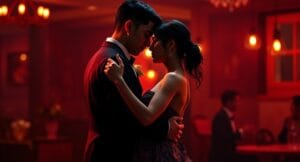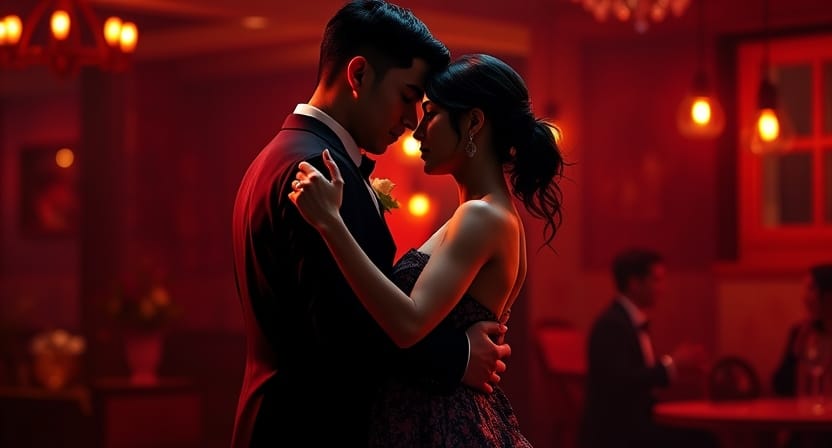
Tango is often described in terms of movement—steps, patterns, direction.
But what defines tango is not motion. It is suspension.
Slow and still, every step is both movement and rest.
Every moment forgets the last and waits for the next.
Suspended in this moment, watching it unfold.
Without the illusion of time, stillness is all that remains.
In tango, nothing is carried forward. There is no accumulation.
Each step completes itself fully, leaving nothing behind.
When momentum enters, tango disappears.
What remains may still look like dancing, but it has lost its core quality: presence without anticipation.
A true step does not aim for the next one.
It arrives, settles, and dissolves.
The follower is not reacting.
The leader is not planning.
Both are listening to the same silence beneath the music.
Time, in this space, does not flow.
It flickers—appearing briefly as weight shifts, then vanishing again.
This is why tango cannot be rushed and cannot be stored.
There is no “better later” step.
There is only this one, now.
When tango is danced this way, technique becomes secondary.
Not because it is unimportant, but because it has no role to play once stillness is intact.
The dance does not move through time.
Time moves through the dance.
And then it stops.
Nothing continues.
Nothing needs to.