I built Amblyopia Reader around a simple question:
If amblyopia is partly about how the two eyes work together, why should training always mean shutting one eye out?
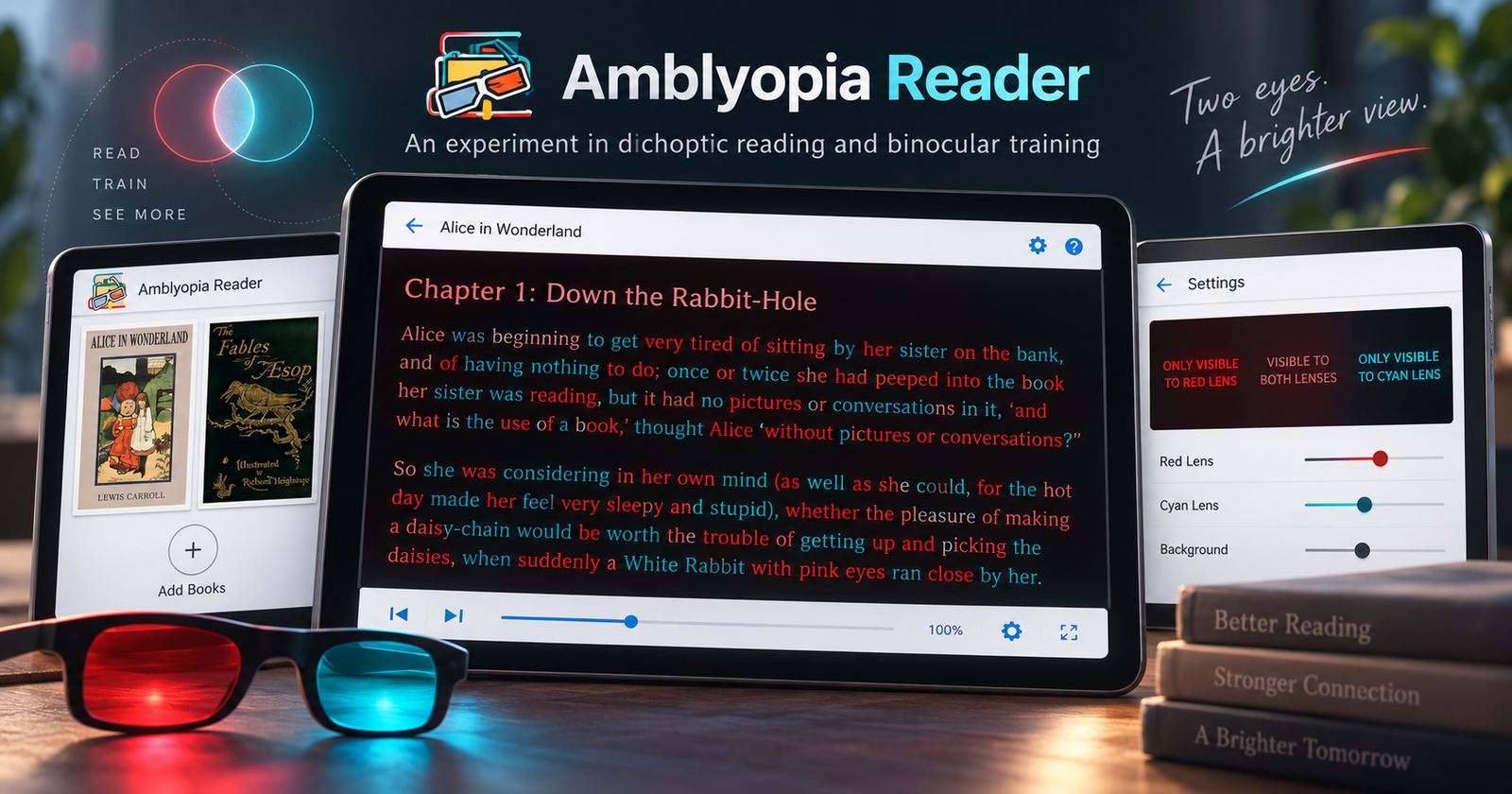
The app uses ordinary red-cyan anaglyph glasses to send slightly different information to each eye while you read. You can adjust the balance so that the weaker eye has to participate without completely removing the stronger eye from the picture.
The easiest way to understand it is to try it.
Open Amblyopia Reader and try it →
This is not a finished medical product. It is a free experiment that I am leaving online for researchers, doctors, and anyone curious enough to explore the idea.
In my own case, after about two weeks of this kind of binocular training, I started noticing depth in a way I had not before.
That is only my experience. It is not proof that the same thing will happen for someone else. But it was striking enough that I felt the project was worth sharing.
How to use it
You will need a pair of cheap red-cyan anaglyph glasses.
1. Calibrate the glasses
Open the app and go to Settings.
You will see three labels:
- only visible to the red lens,
- visible to both lenses,
- only visible to the cyan lens.
Put on the glasses and adjust the red, cyan, and background sliders until the separation is reasonably clean.
The red-only text should be easy to see through one lens and very faint through the other. The cyan-only text should do the opposite. The middle text should remain visible to both.
Do not obsess over perfect calibration. Get it close enough that each eye is clearly receiving different information.
2. Read normally first
Go back to the bookshelf, choose a book, and just read.
Start with the display static. Do not turn on all the experimental controls immediately.
The first thing to notice is simply what happens when both eyes have to contribute to the same act of reading.
You may notice one colour disappearing more easily than the other, one eye dominating, or the text gradually becoming easier to combine.
3. Make the text comfortable
Use the zoom controls if you need them.
The point is not to make reading unnecessarily hard. You want a task that is challenging enough to involve both eyes, but comfortable enough that you can actually keep doing it.
4. Play with suppression
The reader lets you change the balance between the two eyes.
If one eye seems to dominate completely, try adjusting the suppression level gradually.
The interesting state is not one eye winning and the other losing. It is the point where both eyes seem to be contributing.
5. Try blinking
Once static reading feels comfortable, try the blinking controls.
These change the visual emphasis over time rather than keeping it fixed.
Start slowly. The aim is to see how alternating emphasis changes binocular perception, not to make the stimulus as aggressive as possible.
6. Try auto-scroll
Once you are comfortable reading manually, try auto-scroll.
That lets you concentrate more on the visual experience and less on interacting with the page.
Again, start slow and increase the speed only if reading remains comfortable.
Why I built it
Patching has been used for amblyopia for a long time, and for good reason. If the stronger eye dominates, covering it forces the weaker eye to work.
But there is an obvious practical problem: people do not always want to do it.
Children resist patches. Adults may dislike them. Even when everyone agrees that the treatment makes sense, doing it consistently can still be difficult.
This is not a trivial detail. A treatment only works if it actually gets used. A systematic review on patching found that compliance is a real problem and that education and behaviour-change strategies can help: Assessing interventions to increase compliance to patching treatment in children with amblyopia: a systematic review and meta-analysis.
That got me interested in a different question:
What if the training could be built into something you already wanted to do?
Reading seemed like a good candidate.
If a book is interesting, you do not need to remind yourself every few minutes that you are doing therapy. You want to know what happens next.
That does not make the visual mechanism less important. It just means motivation becomes part of the design instead of something added afterward.
Why use both eyes?
Amblyopia is often described as “lazy eye,” but that phrase hides a lot of what is going on.
The problem is not always that one eye is physically incapable of seeing. A major part of amblyopia involves how the brain handles and combines input from the two eyes.
Newer binocular approaches therefore try to reduce the stronger eye’s dominance without removing it completely.
This is the idea behind dichoptic training.
Each eye sees something slightly different. The balance can be adjusted so that the weaker eye gets a fairer chance to contribute, and the brain has to combine information from both sides.
A useful overview is Harnessing brain plasticity to improve binocular vision in amblyopia: An evidence-based update.
A broader review of newer binocular approaches, including games, movies, and other digital systems, is Current Management of Amblyopia with New Technologies for Binocular Treatment.
A simple way of putting the difference is this:
Patching says: use the weaker eye because the stronger eye is unavailable.
Dichoptic training asks: can both eyes stay involved while the visual system learns to stop suppressing one of them?
Why reading interests me
A lot of binocular amblyopia work has used games, movies, VR, and artificial visual tasks. All of those make sense.
But reading has one big advantage: people can genuinely want to keep doing it.
If someone is absorbed in a book, an article, or a story, the training can sit underneath the activity instead of becoming the whole activity.
That matters to me because I think compliance and desire are often treated as secondary issues when they are actually part of the treatment problem.
The best exercise in the world is not very useful if someone avoids it.
The interesting design problem is therefore not just:
What stimulus might improve binocular vision?
It is also:
What kind of experience will someone willingly repeat often enough for learning to happen?
What the research says
The evidence around binocular and dichoptic treatment is promising, but it is not settled.
A 2021 meta-analysis found encouraging results for binocular therapy, including visual-acuity improvement in pooled analysis, although there was no clear advantage for stereoacuity: Comparison between binocular therapy and patching for treatment of amblyopia: a meta-analysis of randomised controlled trials.
A newer 2026 meta-analysis was more cautious. It looked at twelve randomized trials involving 1,034 children and found no significant overall difference between dichoptic therapy and patching in visual acuity, stereoacuity, compliance, or adverse events: The efficacy and safety of dichoptic therapy in comparison to patching in children with amblyopia: A systematic review and meta-analysis.
So I would not describe dichoptic treatment as simply “better than patching.”
The more accurate conclusion is that amblyopia is increasingly being treated as a binocular neural problem, binocular training is a serious research direction, and the field is still working out which approaches work best for which people.
There is also growing evidence that useful visual plasticity does not disappear completely in adulthood. For that, see Harnessing brain plasticity to improve binocular vision in amblyopia: An evidence-based update and Treatment strategies for amblyopia in adults: an overview of conventional methods and new technologies.
My own experience
I did not build this as a purely theoretical exercise. I used it myself.
After roughly two weeks of binocular training, I started noticing depth in a way that felt new to me. Some scenes stopped feeling completely flat and began to have a clearer sense of layers and distance.
I cannot prove from my own experience that Amblyopia Reader caused that change. There were no controls, no formal measurements, and it is one person’s experience.
But it was real enough to me that I wanted to keep the project available instead of letting it disappear into an old folder.
Why I am leaving it online
Amblyopia Reader is not a commercial medical product and it is not a substitute for professional care.
It is a prototype.
I am leaving it online because I think the idea is worth exploring further.
A researcher might see a simple starting point for a better experiment.
A doctor or vision specialist might find it useful for demonstrating the idea of binocular balancing.
A programmer might want to replace the red-cyan glasses with proper stereo displays, eye tracking, adaptive contrast, VR, or something much better.
And someone with amblyopia may simply want to understand what dichoptic training feels like.
The larger idea
The part that interests me most is not really the red and cyan glasses.
It is the broader idea of designing treatment around something a person actually wants to do.
Reading is one possibility. Games are another. Movies, VR, and other kinds of interactive media may be better for other people.
Future systems could do much more than this little prototype does. They could track each eye, measure suppression continuously, adapt contrast automatically, change spatial frequency, adjust difficulty, and personalize the experience as someone improves.
But I would still want to keep the same principle:
make the training useful enough that people want to come back to it.
Desire does not replace neuroplasticity.
It helps create the repeated experience through which neuroplasticity can actually do something.
References and further reading
- Harnessing brain plasticity to improve binocular vision in amblyopia: An evidence-based update
- Current Management of Amblyopia with New Technologies for Binocular Treatment
- Comparison between binocular therapy and patching for treatment of amblyopia: a meta-analysis of randomised controlled trials
- The efficacy and safety of dichoptic therapy in comparison to patching in children with amblyopia: A systematic review and meta-analysis
- Assessing interventions to increase compliance to patching treatment in children with amblyopia: a systematic review and meta-analysis
- Treatment strategies for amblyopia in adults: an overview of conventional methods and new technologies
Important: Amblyopia Reader is an experimental project, not medical advice or a regulated medical device. Amblyopia has different causes and subtypes, and not every form of binocular training will be appropriate for every person. If you intend to use it therapeutically, it is sensible to do so with guidance from a qualified eye-care professional.